
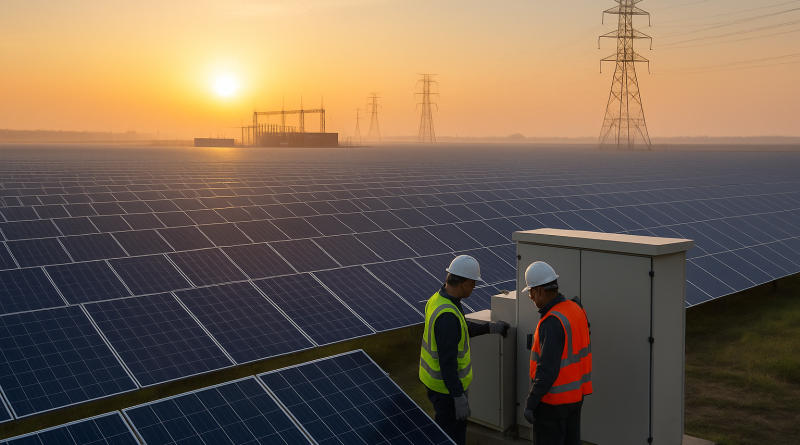
Solar Energy Surge Reshapes Power Markets and Climate Goals in 2025
Solar energy has moved from a niche clean-power option to one of the central forces shaping electricity markets, industrial policy and climate strategy around the world. After years of falling technology costs and rapid manufacturing growth, solar power is now being installed at a pace that is altering how utilities plan grids, how businesses buy electricity and how governments approach energy security.
The shift is visible in the numbers. The International Energy Agency has reported that solar photovoltaic capacity has been growing faster than any other major source of electricity, with global additions reaching record levels in recent years. China remains the dominant market, both as the largest installer of solar panels and the leading manufacturer of modules, inverters and battery components. The United States, the European Union, India and several countries in the Middle East and Latin America have also accelerated solar development as they seek to reduce reliance on imported fossil fuels and meet emissions targets.
One of the biggest drivers is cost. Utility-scale solar projects are now among the cheapest sources of new electricity in many regions, particularly where sunlight is abundant and financing conditions are favorable. The price of solar modules fell sharply in 2023 and 2024 as manufacturing capacity expanded, especially in Asia. That has made large solar farms more attractive to utilities and independent power producers, while also improving the economics of rooftop systems for homeowners, schools, warehouses and local governments.
Businesses are playing an increasingly important role. Large technology companies, retailers and manufacturers have signed long-term power purchase agreements to secure clean electricity and stabilize energy costs. Data centers, whose electricity demand is rising with the growth of artificial intelligence and cloud computing, are becoming major buyers of renewable power. Solar is often paired with battery storage to help companies use clean electricity beyond daylight hours and reduce exposure to peak power prices.
The expansion is also changing the daily rhythm of electricity markets. In places such as California, Australia and parts of Europe, solar output can be so high during midday that wholesale electricity prices fall sharply, sometimes turning negative. That trend benefits consumers when managed well, but it also creates challenges for grid operators, who must balance supply and demand when solar generation drops in the evening. As a result, investment in batteries, transmission lines, demand-response programs and more flexible power plants is becoming increasingly important.
Grid congestion has emerged as one of the main barriers to faster deployment. In many countries, solar projects are waiting years for permission to connect to the electricity network. Aging transmission systems were often designed around large coal, gas or nuclear plants, not thousands of distributed solar installations and remote renewable energy zones. Governments are responding with permitting reforms, grid investment plans and incentives for storage, but developers say interconnection delays remain a significant obstacle.
Policy support continues to shape the sector. In the United States, tax credits under the Inflation Reduction Act have encouraged domestic solar manufacturing and project development. The European Union has promoted solar as part of its response to the energy shock triggered by Russia’s invasion of Ukraine, while also debating how to protect local manufacturers from intense price competition. India has expanded incentives for domestic production and large solar parks as it aims to meet rising electricity demand without a comparable increase in coal use.
The industry still faces economic and environmental questions. Low panel prices have helped customers but put pressure on manufacturers, with some companies reporting squeezed margins. Concerns over supply-chain concentration, labor standards and trade disputes continue to influence procurement decisions. At the same time, the growing volume of panels expected to reach the end of their working life in coming decades has raised interest in recycling systems that can recover glass, aluminum, silicon and critical minerals.
Land use is another issue. Large solar farms can require significant space, leading to local debates over farmland, wildlife habitat and visual impact. Developers are increasingly using dual-use approaches, including agrivoltaics, where panels are installed above crops or grazing land, and projects built on former mines, landfills and industrial sites. Rooftop solar, carport systems and community solar programs can also reduce land pressure while broadening access for renters and households that cannot install panels directly.
Despite these challenges, energy analysts expect solar power to remain a leading source of new electricity capacity. Its modular design allows projects to range from small home systems to massive utility-scale plants, and construction timelines are often shorter than those for conventional power stations. When combined with storage, stronger grids and smarter electricity pricing, solar can contribute not only to emissions reduction but also to resilience during heat waves and periods of high demand.
The next phase of solar growth will depend less on the panels themselves and more on the systems built around them. Financing, permitting, storage, transmission and market rules will determine how much of solar’s potential can be converted into reliable power. For governments and energy companies, the central question is no longer whether solar will be part of the future grid, but how quickly that grid can adapt to a technology that is already reshaping the present.